



Sewing with Unconventional Materials
Working with parachute material requires a complete mindset shift for a tailor. Fluid evening wear fabrics flow naturally over the body, but unconventional fabrics behave quite differently. The parachute was engineered to catch air and withstand extreme wind resistance. Consequently, the fabric naturally has volume, and holds its shape.
Repurposing historical textiles also requires a careful assessment of the fabric’s integrity. The tailor must navigate around any weathered places and utilize the strongest sections of the parachute to build the garment. Even failing to use the correct needle could result in skipped stitches and damage to the fabric.
Constructing the Dress
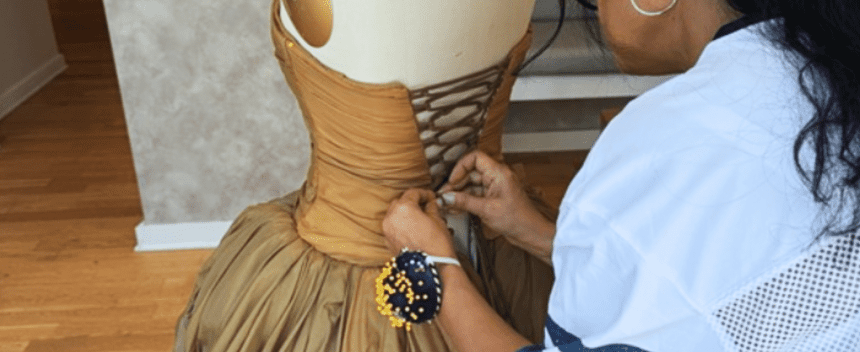
Farida bypassed flat pattern making for this project, as unpredictable materials rarely behave according to a two-dimensional paper pattern. She instead began by working directly on a dress form. This hands-on draping technique allowed her to understand the natural weight and behavior of the parachute material. By pinning the massive canopy section by section, Farida established the flow and structure of the gown. Draping on the form provides immediate feedback on how the fabric would interact with the wearer.
Engineering the Strapless Corset
The physical structure of this parachute dress draws heavy inspiration from Audrey Hepburn’s iconic “Sabrina” gown. Hubert de Givenchy designed the original dress for the 1954 film. The signature look relies on a stark visual contrast between a tightly contained upper half and a massive skirt.
To achieve the tightly fitted upper bodice, Farida added a rigid strapless corset. The inner corset provides the foundational scaffolding needed to anchor the entire gown, while a standard unboned bodice wouldn’t hold the weight of the heavy skirt. This internal support also ensures the bodice remains smooth and closely fitted against the torso.
Parachute Cord Lacing
The corset is fastened at the back using the parachute cord itself. Instead of defaulting to traditional corset ribbons, Farida chose to utilize the original parachute hardware. This functional detail serves as a brilliant homage to the material’s WWII origins. A creative way to use the entire parachute, the cord adds a unique and conversation worthy detail to the gown.
Mastering the Voluminous Silhouette
The true drama of the silhouette comes from the bottom half of the gown. The tightly contained top bodice contrasts with a skirt that heavily expands in volume. Because the material naturally traps air, the skirt maintains a beautifully inflated shape as the wearer walks. Managing this skirt requires careful attention to the hemline. The tailor must balance the proportions so the massive volume frames the wearer rather than swallowing them whole. The resulting visual is a sweeping, architectural skirt that commands space in any room.

Marie Claire Feature
What started as a rugged piece of WWII history is now a vision of Audrey Hepburn-inspired glamour. Executing this ambitious sewing project in just 15 days was the ultimate test of working with unconventional materials. But seeing Farida bring this vintage parachute to life proves that even a parachute can truly achieve high-fashion elegance. A transformation so stunning, it even earned a feature in the pages of Marie Claire UA!
